
The story behind the bottleStephanie’s Story
I did not set out to become the person who measures potassium by the 1/16th teaspoon at her kitchen counter. I started running the way most people do — two feet and a heartbeat — and for a long time that was enough.
Then the runs got longer, the races got more serious, and the bonk started showing up in the last few kilometres. The obvious fix was gels. But at roughly five dollars each, the idea of taking two or three on an ordinary training run felt absurd on top of shoes, entry fees, and everything else running already costs. I wanted something I could practise with as often as I needed to, without flinching every time I opened a wrapper.
So I started mixing my own. The recipe below is deliberately boring, and that is the point: it is cheap enough to rehearse, simple enough to make the same way twice, and gentle enough that my stomach learned to expect it. The gut is trainable, just like the legs and the lungs. The version I drink now is double the carbohydrate I started with, but I only got there by nudging the amounts up slowly and paying attention to what my stomach told me.
The cost was not a small detail. Four gels on a training run is about twenty dollars, and if that plan works, you get to spend the same twenty dollars again on race day. That is hard to repeat often enough to actually train the gut, and it made every test feel too precious. A homemade bottle let me practise the same fueling pattern on ordinary runs without treating every long run like a checkout-lane decision.
It also gave me fewer variables. With packaged race gels, I had to accept the exact potassium, sodium, caffeine, glucose-to-fructose mix, stabilizers, flavourings, and additives chosen by the manufacturer. Even the word “natural” does not remove the uncertainty: Canadian Food Inspection Agency guidance allows natural flavour claims for plant- or animal-derived flavouring substances, and says acids, bases, salts, and sweeteners can be used with natural flavours without changing that status. For a sensitive gut, that is a lot of unknown chemistry to troubleshoot at race pace.
Everything below this story is the broader guide, organized by where you are as a runner. The recipe stays the same on every tab; the advice for how hard to push it changes as the distance grows.
Stephanie’s kitchen recipe
Basic Beginner Fueling Recipe
32 g carbs / 500 mL — 20 g glucose : 12 g fructose. Adjust honey and maltodextrin amounts as needed.
Per 500 mL race fuel
- ½ C boiling water + 1.5 C cool water
- ¾ tbsp honey or maple syrup (maple may be slightly easier on tummy)
- 2 tbsp maltodextrin
- 1/16 – 1/8th tsp potassium
- ¼ tsp table salt (I like pink salt, but any will do)
Directions
- Add honey or maple syrup and maltodextrin to boiling water. Mix well.
- Add salt and potassium. Mix well.
- Add cool water.
- Cool off in fridge before adding to soft “shrink as you drink” flasks.
If in a time crunch, add ice cubes to cool down appropriately.
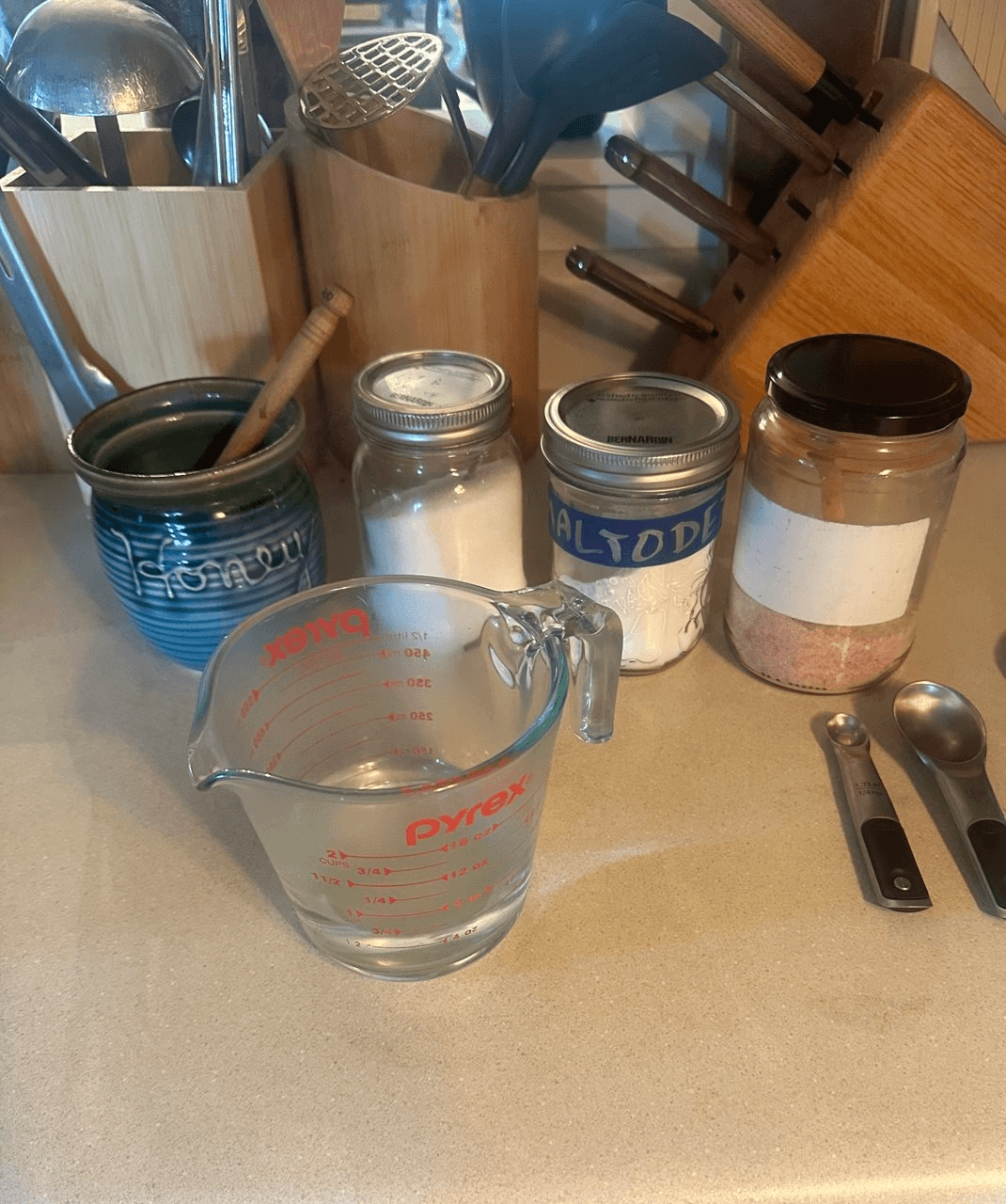
Over time, I have worked up to double the amounts of maltodextrin and honey. I started with maple syrup which tastes much inferior to honey.
Women, I suggest using 250 mL flasks, men 500 mL. Depending on hand size, a 500 mL bottle flops around quite a bit in a small hand, when full.
The full guide, by level
Beginner level
A Beginner Guide
Fueling a race is simple, and like all simple things, it is hard. Stephanie sees the same two race-week mistakes over and over.
The basic rule is this: the shorter the race, the more you protect comfort and speed. The longer the race, the more you protect carbohydrate availability, blood volume, and a gut that has already practiced the plan.
The gut needs training just like the cardiovascular or musculoskeletal system. It is easy to understand why a new runner wouldn't think to fuel during a run. Race gels are pushing $5 per gel, and thinking about taking 3 on a training run is an outrage. Running shoes already cost $2+ per run, race entry fees are going north of $100 for a local half marathon, and the old adage - two feet and a heartbeat - seems farther and farther away.
At-home solutions, even for a beginner, can seem like the only way.
It's easier than ever to order maltodextrin powder online, potassium salt, and other esoteric ingredients for your personalized brew. Whatever exact recipe you use to tune the mix to your own gut, you have to accept that it becomes yet another step in the ritual of getting ready to run.
Taking on fuel for training helps because the gut adapts to what it repeatedly sees. The product, dose, concentration, timing, and movement all become part of the training stimulus. Research on gut training describes improved stomach comfort, better carbohydrate absorption, and fewer GI symptoms when runners practice race-like fueling before the race. In beginner language: make the boring version familiar in training, so race day is not the first time your stomach gets the job. [2, 4]
If you have heard runners talk about 100 g/hour, treat that as an advanced number, not a beginner target. The direct muscle-damage research used elite, gut-trained mountain marathon runners taking 120 g/hour from 2:1 maltodextrin-fructose gels. That takes significant gut training to absorb without GI distress. The beginner takeaway is smaller and safer: glucose/fructose mixes can help when long-race intake gets high, but only after the gut proves it can handle the plan. [3, 5, 6]
What to eat before a race with a sensitive stomach
The shorter the race, the more you protect comfort and speed. The longer the race, the more you protect carbohydrate availability, blood volume, and a gut that has already practiced the plan.
| Race | Beginner priority | Simple plan |
|---|---|---|
| 800m to mile | Light stomach, normal energy | Eat normally the day before. Have a familiar low-fiber meal 2 to 4 hours before. No gel needed. |
| 3K to 5K | Arrive hydrated, not stuffed | Use a small carbohydrate breakfast if racing in the morning. Keep fat and fiber low. A mouth rinse or tiny pre-start carb is optional. |
| 10K | Enough carbohydrate, minimal gut bulk | Shift toward easier carbs the day before. Breakfast 2 to 4 hours out. During-race fuel is usually optional unless you will be out longer than about 60 minutes. |
| Half marathon | Practice fluids and carbs | Start practicing 30 to 60 g carbohydrate per hour on long runs. Race morning should be familiar, boring, and low residue. |
| Marathon | Do not wing it | Practice 30 to 60 g carbohydrate per hour on long runs, then race with the schedule your gut already knows. Carb-load, reduce fiber, and pair water with sodium instead of drinking plain water endlessly. |
How to test your fueling before race day
- Nothing new on race day. New gels, drink mixes, caffeine doses, and bars should be tested in training.
- Keep short races light. For 800m, mile, 3K, and most 5K races, extra gut contents are more likely to hurt than help.
- Use white, simple carbs before longer races. Bagels, white rice, potatoes, toast, bananas, applesauce, sports drink, and low-fiber cereal are common options.
- Taper fiber before half marathon and marathon efforts. The goal is not to eat "dirty"; it is to reduce residue and cramping risk.
- Hydrate without overdrinking. Start the race normally hydrated. Do not force large volumes of plain water if your urine is already clear and you are not thirsty.
Simple race-day fueling by distance
For a healthy beginner runner, Stephanie's starting point is conservative:
- 800m to 5K: normal meals, low-fiber pre-race meal, no during-race calories.
- 10K: normal meals plus a carbohydrate-led breakfast. If the race will take more than 60 minutes, consider 10 to 25 g carbohydrate during or just before the start.
- Half marathon: practice 30 to 45 g carbohydrate per hour before aiming higher.
- Marathon: build toward 45 to 60 g carbohydrate per hour first. Only move higher after your gut proves it can handle it.
Do not confuse dehydration with hyponatremia
No one wants to be the stumbling, confused runner who cannot stand steadily on their own two feet. Long races create two opposite risks: too little fluid and too much low-sodium fluid. Confusion, nausea, weakness, headache, vomiting, swelling, and severe fatigue can occur with dehydration, but they can also occur with exercise-associated hyponatremia, where blood sodium is diluted. For long races, the message is simple: sodium belongs in the plan, and plain water should not be endless. If serious symptoms appear, stop racing and flag down a race marshal, medical volunteer, or aid-station worker. Organized Canadian races are expected to have safety and medical planning; use that help instead of trying to fix severe symptoms by chugging plain water. [7, 8]
Bottom line
Short races reward a light, calm gut. Long races reward a practiced plan. The beginner win is not a perfect spreadsheet; it is avoiding extremes, rehearsing the basics, and matching the fuel to the race.
When to work with a running coach or physiotherapist
If stomach issues keep ending workouts early, if race plans feel like guesswork, or if pain changes how you run, it can help to have someone look at the whole picture: training load, pacing, strength, symptoms, and fueling. Stephanie works with runners in Kelowna through running coaching and physiotherapy so the race-day plan fits the body doing the racing.
Sources
- Stellingwerff T, Bovim IM, Whitfield J. Contemporary Nutrition Interventions to Optimize Performance in Middle-Distance Runners.
- Jeukendrup AE. Training the Gut for Athletes.
- Fuchs CJ, Gonzalez JT, van Loon LJC. Fructose co-ingestion to increase carbohydrate availability in athletes.
- Martinez IG, et al. The Effect of Gut-Training and Feeding-Challenge on Markers of Gastrointestinal Status in Response to Endurance Exercise.
- Viribay A, et al. Effects of 120 g/h of Carbohydrates Intake during a Mountain Marathon on Exercise-Induced Muscle Damage in Elite Runners.
- Urdampilleta A, et al. Effects of 120 vs. 60 and 90 g/h Carbohydrate Intake during a Trail Marathon on Neuromuscular Function and High Intensity Run Capacity Recovery.
- Hew-Butler T, et al. Statement of the Third International Exercise-Associated Hyponatremia Consensus Development Conference.
- Athletics Canada Road. National Road Race Standards badges and event safety planning.
Intermediate level
The Working Numbers
Most runners do not learn race fueling from a spreadsheet. They learn it the hard way: training is solid, but one gel is not enough and the bonk starts creeping in during the final 5K; the day is hotter than expected and the half marathon suddenly needs more sodium; or a new gel turns the stomach sour and steals attention from running well.
The rule is simple: short races protect comfort and speed; long races protect carbohydrate availability, blood volume, sodium, and a gut that has already practiced the plan. The intermediate step is where the numbers become useful without becoming a spreadsheet religion.
This guide is for healthy adult runners who are ready to plan more deliberately. It is still a rough guide, not individualized nutrition, medical, or performance advice. Your needs can change with sex, body size, training status, heat, sweat rate, medications, GI history, and race duration.
The examples below use a 70 kg runner because it makes the math concrete. Scale the g/kg and ml/kg ranges to your own body mass, then test the plan in training before racing it.
Before you mix your own brew
At-home solutions can work well for intermediate runners. Maltodextrin, sugar or fructose, sodium, and flavoring can create a cheaper bottle than race gels. But the standard is not whether the mix looks smart on paper. The standard is whether you can make it the same way twice, carry it comfortably, drink it at race pace, and tolerate it when your gut has less blood flow than it wants.
If the homemade version adds too much friction, use the boring commercial option. If the commercial option is too expensive to practice, simplify the homemade version until it is repeatable. A fueling plan that never gets rehearsed is not a plan.
Race fueling matrix for an average runner
Use this table as a duration filter, not a commandment. If the race is short, protect a light stomach and fast legs. If the race is long, protect the supply line: carbohydrate, fluid, sodium, and a gut that has rehearsed the work.
| Race | T-48h to T-24h carbs | Race morning | During race | Hydration/sodium |
|---|---|---|---|---|
| 800m | 3-6 g/kg/day. For 70 kg: 210-420 g/day. | 1-2 g/kg carbs 3-4h out if needed. Keep volume small. | 0 g. Optional mouth rinse only. | 5-7 ml/kg 4h out. For 70 kg: 350-490 ml. |
| 1500m / mile | 5-7 g/kg/day. For 70 kg: 350-490 g/day. | 1-2 g/kg 2-4h out. Toast, bagel, oats, rice, banana. | 0 g. Tiny 10-15 g pre-start carb only if practiced. | Normal electrolytes. Avoid hyperhydration. |
| 3K / 5K | 5-8 g/kg/day. For 70 kg: 350-560 g/day. | 1-2 g/kg 2-3h out. Low fat, low fiber. | 0 g for most runners. Mouth rinse or 10-20 g in final 10 min if tested. | Start euhydrated. Add 300-600 mg sodium with morning fluids if hot or salty sweater. |
| 10K | 6-8 g/kg/day. For 70 kg: 420-560 g/day. | 1-3 g/kg 2-4h out. For 70 kg: 70-210 g. | 0-30 g/h. If slower than 60 min, consider 20-30 g/h. | Usually 0-400 ml/h unless hot. Do not gain weight from fluid. |
| Half marathon | 7-10 g/kg/day for 24-48h. For 70 kg: 490-700 g/day. | 2-4 g/kg 3-4h out. For 70 kg: 140-280 g. | 30-60 g/h. Faster runners may need only one gel; slower runners need more time-based fuel. | 400-800 ml/h as tolerated and conditions demand. Include sodium if sweating heavily. |
| Marathon | 8-12 g/kg/day for 36-48h. For 70 kg: 560-840 g/day. | 1-4 g/kg 3-4h out. For 70 kg: 70-280 g, low fiber and low fat. | 45-60 g/h to start. Build to 60-90 g/h if gut-trained. Elite or heavily gut-trained upper work may reach 90-120 g/h, but that is not a cold race-day experiment. | Common range: 450-750 ml/h. Sodium often 500-1000 mg/L or enough to match sweat without overdrinking. |
Protein, fat, and fiber: the digestion-speed layer
| Nutrient | Useful range | Race-week use |
|---|---|---|
| Protein | Daily: 1.2-2.0 g/kg. For 70 kg: 84-140 g/day. | Keep the pre-race meal moderate. In the final 2h, avoid heavy protein. During marathon fueling, keep protein minimal unless using ultra-style food. |
| Fat | Often at least 20-25% of daily energy, or roughly 0.6-1.0 g/kg/day as a practical floor. | Do not cut fat chronically, but keep it low in the final pre-race meal because it slows digestion. |
| Fiber | Normal training intake is individual. Low-residue race taper often means about 10-15 g/day in the final 24h for sensitive runners. | For half marathon and marathon, reduce beans, bran, large salads, cruciferous vegetables, and whole grains 24-48h out if they bother your gut. |
Practice is the real upgrade
The gut adapts to what it repeatedly sees. Practice does not have to mean taking gels on every run. It means choosing specific sessions where you rehearse the dose, concentration, timing, and product format you expect to race with. Long runs, marathon-pace work, and heat exposure are better tests than easy jogs around the block. That is the long-race side of the rule: the fuel only helps if the gut can keep delivering it.
Write down what happened. Note pace, heat, fluid volume, sodium, carbohydrate grams per hour, caffeine, urgency, nausea, stitch, bloating, and whether the plan was easy to execute. That symptom log is more useful than guessing after race day.
Why glucose-fructose matters after 60 g/hour
If you are taking less than about 60 g carbohydrate per hour, the exact carbohydrate blend matters less. Once you push above that, glucose-only fueling can saturate the main glucose transporter. Mixed transportable carbohydrate - usually glucose or maltodextrin plus fructose - uses more than one pathway and can raise total carbohydrate availability.
If you have heard runners talk about 100 g/hour plans, put that number in context. That level is not a personality test. It is a trained tolerance target for longer races, usually built gradually from 30 to 45 g/hour, then 45 to 60 g/hour, then higher only if the gut stays calm and the race actually needs it.
Caffeine numbers without the bravado
Start low. Many runners do well with 1-3 mg/kg caffeine 45-60 minutes before a race. A common evidence-based range is 3-6 mg/kg, but that can be too much for anxious, caffeine-sensitive, smaller, or GI-prone runners. For 70 kg, 1-3 mg/kg is 70-210 mg; 3-6 mg/kg is 210-420 mg. Marathoners using caffeinated gels should count the total across the whole race.
Race-day timing
- 3-4 hours before: the main carbohydrate meal.
- 60 minutes before: avoid a new large carb bolus if you are prone to rebound low blood sugar or stomach upset.
- Final 10 minutes: a small 10-20 g carbohydrate hit or mouth rinse can be useful because it is too close to the start to create the same pre-race digestion problem.
- Every 10-20 minutes in longer races: small repeat doses usually beat large emergency doses.
Safety check
Do not chase numbers blindly. No one wants to become the stumbling, confused runner who cannot stand steadily on their own feet. If you are nauseated, confused, vomiting, swelling, wheezing, faint, or unusually disoriented, stop and get medical support from a race marshal, aid station, or medical volunteer. Dehydration and hyponatremia can look similar from the outside, and the wrong fluid choice can make the problem worse. For long races, sodium belongs in the plan, but sodium does not make endless plain-water drinking safe. [7, 8]
Sources
- Jeukendrup AE. Training the Gut for Athletes.
- Fuchs CJ, Gonzalez JT, van Loon LJC. Fructose co-ingestion to increase carbohydrate availability in athletes.
- Dominguez R, et al. Nutritional needs in the professional practice of swimming: a review.
- Stellingwerff T, Bovim IM, Whitfield J. Contemporary Nutrition Interventions to Optimize Performance in Middle-Distance Runners.
- Viribay A, et al. Effects of 120 g/h of Carbohydrates Intake during a Mountain Marathon.
- Guest NS, et al. International society of sports nutrition position stand: caffeine and exercise performance.
- Hew-Butler T, et al. Statement of the Third International Exercise-Associated Hyponatremia Consensus Development Conference.
- Athletics Canada Road. National Road Race Standards badges and event safety planning.
Expert level
The Advanced Gut Plan
Advanced race fueling is where familiar race-day mistakes get more expensive. The athlete may have the right training, the right pace, and the right ambition, but the wrong bottle concentration, a late carbohydrate gap, a caffeine stack, heat, or too much plain water can still turn the final kilometres into damage control.
At the advanced end, race fueling is still simple in theory and hard in execution. Shorter races protect comfort and speed. Longer races protect carbohydrate availability, blood volume, sodium, and a gut that has already practiced the plan. The best answer changes by distance because the bottleneck changes by distance.
This advanced layer is for runners and coaches who want the physiology behind the practical rules. It is still educational, not individualized medical advice. Use it to understand the logic, then individualize with testing, sweat-rate data, medical history, and professional support where needed.
The advanced mistake is the polished version of the beginner mistake: chasing the most sophisticated race-day plan without doing the boring training that makes it tolerable. If you have heard of 100 g/hour glucose-fructose plans, the number only matters if the athlete has taught the gut how to absorb it while running hard.
The operating principles
| Principle | Applies most to | Performance consequence |
|---|---|---|
| Energy system continuum | 800m to 5K | The 800m through 5K sit at extreme intensities. The priority is carbohydrate-supported glycolytic flux, buffering, neuromuscular output, and low non-functional mass. |
| Glycogen economics | 10K to marathon | As race duration rises, carbohydrate stores and exogenous carbohydrate delivery become more important. Aggressive loading is wasteful for short races and essential for marathon-level risk. |
| The gut is trainable | Half marathon, marathon, ultra | Gastric comfort, carbohydrate absorption, and tolerance of higher intake improve with repeated exposure. Race-day fueling should be trained like race pace. |
| Transporter saturation | Any event above 60 g/h intake | Glucose delivery through SGLT1 tends to plateau around 60 g/h. Fructose uses GLUT5, so glucose-fructose blends can raise total exogenous carbohydrate availability. |
| Fluid is not free | Hot 10K, half marathon, marathon | Dehydration can reduce performance, but overdrinking low-sodium fluid can cause hyponatremia. The target is stable body mass trend, not maximal intake. |
In plain language, the short-race side is about arriving fueled without carrying extra gut load. The long-race side is about keeping the supply line working after pace, heat, stress, and time start making absorption harder.
Distance-specific physiology
800m to mile: These races are short enough that total glycogen depletion is not the limiter. They are long enough that aerobic contribution is substantial and short enough that anaerobic contribution, acidosis, and neuromuscular fatigue matter. Nutrition should support high carbohydrate availability without adding gut mass. Caffeine or bicarbonate may be relevant for some advanced athletes, but both carry GI and tolerance tradeoffs.
3K to 5K: The race is mostly aerobic but still near the top of sustainable intensity. Fueling is usually pre-race, not during-race. The practical failure mode is arriving underhydrated, over-caffeinated, overfed, or with too much fiber in the gut.
10K: The 10K is still short enough that many runners do not need during-race calories, but long enough that carbohydrate availability, heat, and fluid loss can matter. A fast 10K in heat can generate meaningful sweat loss while intensity reduces gut blood flow.
Half marathon: The half marathon is the transition point where time on course determines the plan. A 70-minute runner and a 2-hour runner are in different fueling worlds. Use duration, not just distance, to set carbohydrate and fluid targets.
Marathon: The marathon is where glycogen depletion, fluid loss, sodium loss, GI tolerance, and pacing mistakes compound. The wall is not one thing; it is often the convergence of low carbohydrate availability, rising perceived effort, heat strain, and reduced ability to absorb what the athlete tries to take late.
The SGLT1 and GLUT5 rule
For lower carbohydrate intakes, a single carbohydrate source can work. Once intake approaches or exceeds about 60 g/h, glucose-only plans become limited by intestinal transport capacity. Mixed transportable carbohydrate (commonly maltodextrin or glucose plus fructose) uses parallel pathways and can raise exogenous carbohydrate oxidation while reducing the amount of unabsorbed sugar sitting in the gut. [3, 4]
The practical upper range is not a badge of toughness. Many athletes should stay at 45-60 g/h. Some gut-trained marathon and ultra athletes may tolerate 60-90 g/h. Research in elite mountain marathon contexts has explored 120 g/h with prior gut training, but that is not a beginner target and should not be copied cold by an advanced runner either. [6, 7]
Gastric emptying and the race-day gut
Gastric emptying is affected by intensity, dehydration, heat, concentration, osmolality, and individual tolerance. During hard running, blood is redistributed away from the gut, and high-volume or concentrated fueling can become a problem. The answer is not simply "drink more"; it is to train the exact dose, concentration, timing, and product format that will be used in the race.
For advanced runners, gut training means scheduled exposure: repeated long runs with carbohydrate, race-like bottle concentration, sodium, caffeine if used, and feeding intervals. Log symptoms alongside pace, heat, fluid volume, and product type. The symptom log is the decision tool.
High-carb plans are adaptation plans
The research conversation around very high carbohydrate intake is not a dare to take more sugar. It is a reminder that muscle damage, fatigue, and late-race failure are affected by carbohydrate availability and by whether the gut can keep delivering fuel. When a runner builds toward higher glucose-fructose intake over time, the plan may support performance and reduce some markers of damage. When a runner copies the number cold, the gut often becomes the limiter. [6, 7]
Stephanie would usually treat 60 g/hour as the first serious checkpoint, not the finish line. From there, increases should be small, rehearsed, and tied to a real race need: longer duration, higher intensity, heat, or a history of fading when carbohydrate availability drops.
Fluid, sodium, and hyponatremia
Performance can fall when fluid loss reaches roughly 2% of body mass, especially in heat. But the opposite error - drinking beyond sweat loss, especially plain water - can dilute blood sodium. Symptoms can overlap: headache, nausea, weakness, vomiting, swelling, fatigue, confusion, and disorientation. The runner who is stumbling, confused, or unable to stand steadily needs medical support, not more guesswork from the aid table. Severe symptoms are a medical problem, not a spreadsheet problem. [9]
A practical long-race range is often 450-750 ml/h, adjusted for sweat rate, heat, body size, and tolerance. Sodium needs vary widely, but long hot races often require sodium-containing fluids or food. A common target is at least 500-1000 mg/L in race fluids for salty sweaters or long heat exposure, with the goal of avoiding both large body-mass loss and body-mass gain. Sodium belongs in the plan, but sodium does not make overdrinking safe. If severe symptoms appear, stop the race plan and get help from race medical staff or a marshal. [9, 10]
Caffeine: useful, not magic
Caffeine can improve alertness, reduce perceived exertion, and support performance. The common evidence-based range is 3-6 mg/kg about 45-60 minutes before exercise, but lower doses of 1-3 mg/kg may be enough with fewer side effects. Long-course runners must count caffeinated gels, drink mix, cola, and pills together. Anxiety, insomnia, racing heart, GI upset, and poor pacing can erase the benefit. [8]
Advanced decision table
| If the athlete is... | Prioritize | Avoid |
|---|---|---|
| Racing 800m to 5K | Normal glycogen, low gut residue, tested caffeine if useful | Aggressive carb loading, heavy breakfast, large sodium/fluid boluses |
| Racing 10K in heat | Euhydration, sodium with breakfast fluids, low-residue carbs | Starting dehydrated or overdrinking plain water |
| Racing half marathon over 90 minutes | 30-60 g/h carbohydrate, practiced fluid rhythm | Waiting until fatigue appears before fueling |
| Racing marathon | 8-12 g/kg/day carbohydrate load, low fiber, 60-90 g/h trained intake, sodium-aware fluids | New gels, glucose-only intake above 60 g/h, caffeine stacking, body-mass gain from fluid |
How Stephanie would pressure-test the plan
Before trusting an advanced plan, write down the body mass, target race, expected finish time, heat forecast, sweat rate if known, usual caffeine intake, GI history, tolerated products, medical constraints, and exactly how many times the plan has been rehearsed. If the answer is "never," the plan is still a draft.
The strongest version of race fueling is not the most complicated one. It is the one the athlete can execute calmly, repeatedly, and safely when the race gets hard.
Sources
- Stellingwerff T, Bovim IM, Whitfield J. Contemporary Nutrition Interventions to Optimize Performance in Middle-Distance Runners.
- Jeukendrup AE. Training the Gut for Athletes.
- Fuchs CJ, Gonzalez JT, van Loon LJC. Fructose co-ingestion to increase carbohydrate availability in athletes.
- Jeukendrup AE. A Step Towards Personalized Sports Nutrition: Carbohydrate Intake During Exercise.
- Dominguez R, et al. Nutritional needs in the professional practice of swimming: a review.
- Viribay A, et al. Effects of 120 g/h of Carbohydrates Intake during a Mountain Marathon.
- Arribalzaga S, et al. Relationship of Carbohydrate Intake during a Single-Stage One-Day Ultra-Trail Race with Fatigue Outcomes and Gastrointestinal Problems.
- Guest NS, et al. International society of sports nutrition position stand: caffeine and exercise performance.
- Hew-Butler T, et al. Statement of the Third International Exercise-Associated Hyponatremia Consensus Development Conference.
- Athletics Canada Road. National Road Race Standards badges and event safety planning.

Continue Reading
One Stride Too Far
The whispers before the roar: a personal story about recognizing injury warning signs before it's too late.
The Architecture of Movement: Understanding NeuroKinetic Therapy (NKT)
Discover how Neurokinetic Therapy (NKT) can help identify and correct movement dysfunction patterns to improve your performance and reduce pain.